
Contrapt  ·  Free & open source

HyperCard, reborn.

For Mac & iPad

Make stacks — cards, buttons, fields, and scripts in plain English. Open the stacks you made in 1989. Publish any of them to the web.

Join the beta

A fan of illustrated cards spreading across a starfield, the front card reading “Your Tour of Contrapt — click to begin.”

☞ Freedom to Associate, Again

“Oh, that reminds me of…” — that's how thinking often works, one idea calling up the next. The original HyperCard brochure from 1987 called this freedom to associate, and the program delivered something personal computers have rarely offered since: a place where ordinary people could make real, working software – a recipe box that dialed the butcher; a field guide with a soundtrack; a choose-your-own adventure written by a nine-year-old. Easy to conceive, easy to build, and nobody needed a computer science degree.

Then the web arrived, HyperCard faded, and millions of stacks were stranded on aging floppies and disk images — still full of their makers' art, writing, and cleverness, but complicated to run on modern hardware.

Contrapt is a reimagining of that whole idea, built new for today's Mac and iPad, complete with cards, backgrounds, buttons, and fields, which you arrange by dragging and editing in place. Tying them together are scripts written in HyperTalk — the same readable language that shipped with the original HyperCard: go to card 3, put the date into field "Today". Visual effects, paint layers, find, sort. And a message box, of course.

It's not an emulator, and it's not nostalgia under glass — it's the original idea itself, given new hardware.
on mouseUp
  go to next card
end mouseUp

That's the whole program. It's attached to the button on the right.

This little card is live on this page, not in a screenshot.

Card 1 of 3

☞ Make stacks

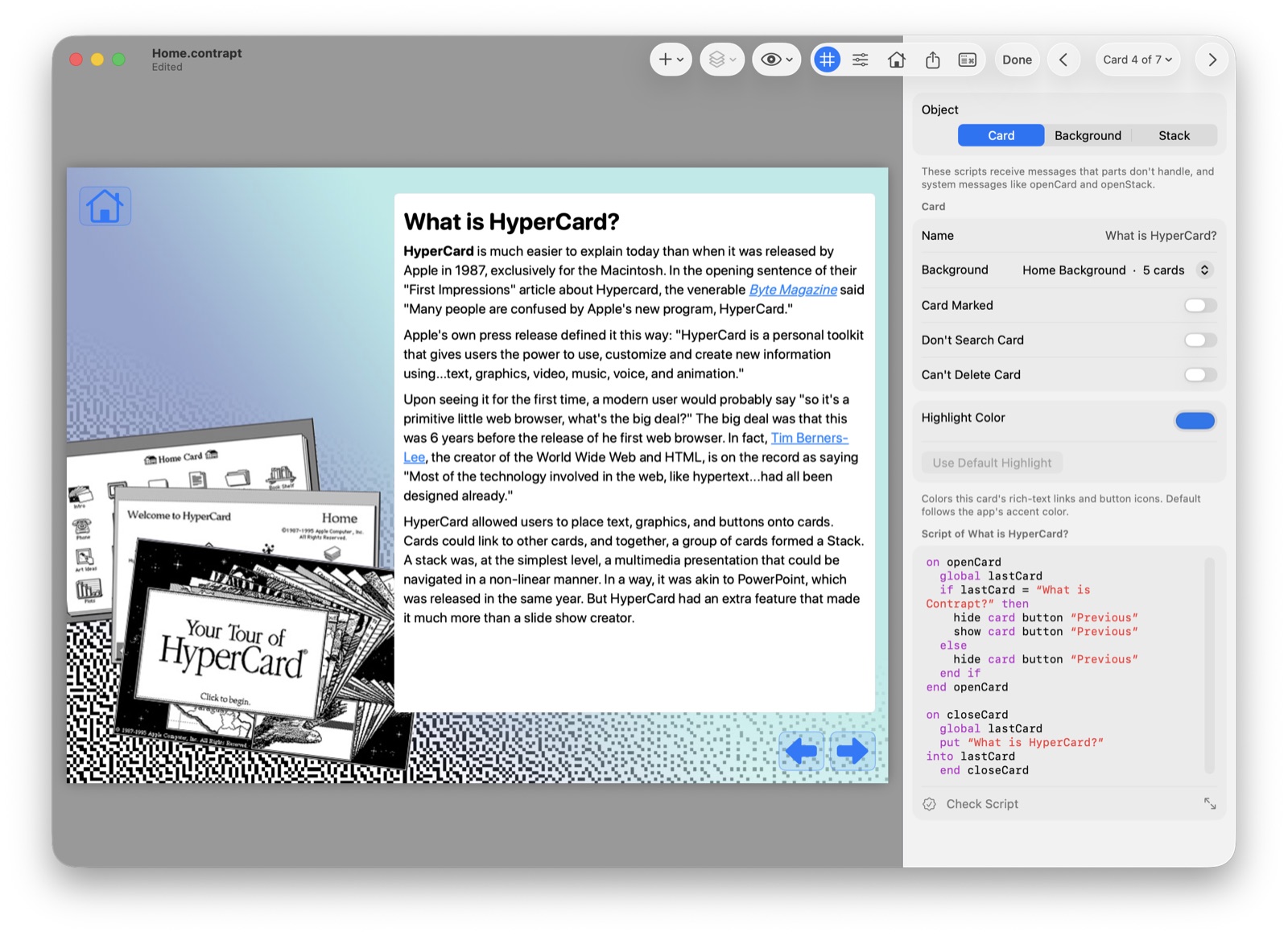
Browse mode runs your stack; edit mode opens it up for tinkering. Select a button, and the inspector shows its name, style, icon, and script — change the script, click the button, and it runs your new code. No build step, no project files, no ceremony. The distance between having an idea and clicking on it is measured in seconds.

Contrapt on the Mac in edit mode: the Home stack's “What is HyperCard?” card, with the inspector showing the card's properties and its openCard HyperTalk script.
Editing a card on the Mac — the inspector holds every part's properties and script.

☞ Rescue your old stacks

Contrapt imports original HyperCard stack files — the structure, the text, the scripts, the 1-bit artwork, the button icons, it even matches the spirit of the original fonts. Your 1989 address book opens in 2026, buttons still clicking, scripts still running. The gray desktop is exactly where you left it.

And that claim is measured, not promised: every build is tested against 4,842 real stacks from the Internet Archive, their scripts parsed and run, with the results — what works, what doesn't yet, what's known broken — published in COMPATIBILITY.md for anyone to read.

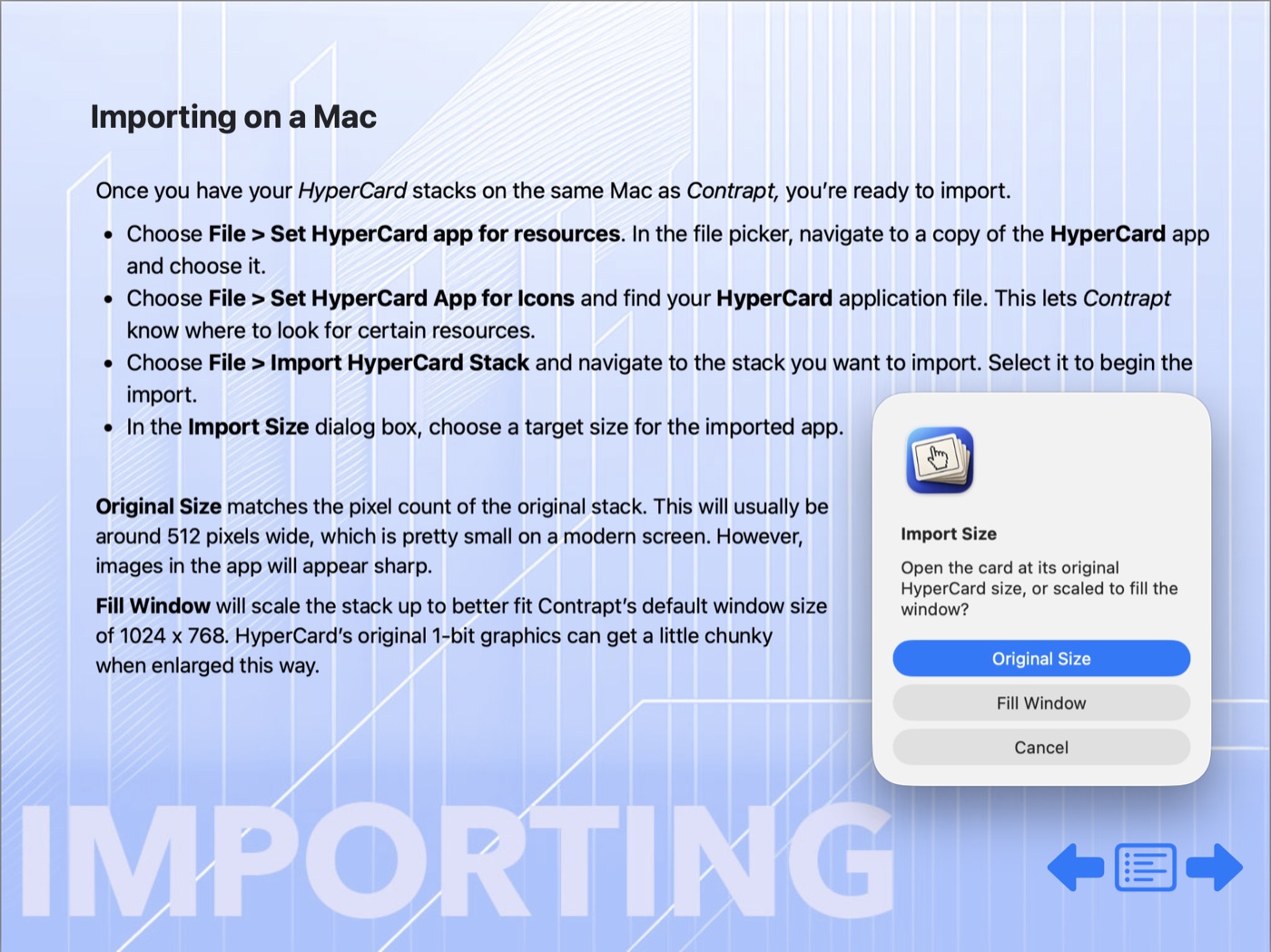
A Contrapt help card titled “Importing on a Mac,” explaining how to import HyperCard stacks, with an Import Size dialog.
The built-in guide to bringing HyperCard stacks forward.

☞ Pick up where it left off

The tools that came after HyperCard asked, “what would a serious programming system look like?” Contrapt asks a different question: what would HyperCard be if Apple had never set it down?

So Contrapt's HyperTalk is the HyperTalk that might have been. It's fully compatible with the original, but knows how to read the live web, to hold structured data and JSON, to remember things between runs, to turn a feed straight into a deck of cards — and, the modern turn, to ask an AI a question and use the answer. Every language addition still reads like the plain English that HyperCard always spoke. The gentle slope is intact: a nine-year-old can still make something real on the first afternoon.

Not HyperCard under glass — HyperCard still being developed.

on mouseUp
  put FeedItems(url "https://example.com/news.xml") into stories
  make a card for each element of stories using background "Story"
end mouseUp

Three lines turn a live news feed into a browsable stack of cards — a kind of program HyperTalk couldn't have written in 1987, in a sentence it could have.

☞ Publish to the web

Any stack can be exported as a self-contained website — the same HyperTalk engine, compiled to WebAssembly, runs your scripts right in the browser. No server code, no accounts, no tracking; host it on any web space you already have.

One honest note if your stack gathers from the live web: a browser only lets a page read from sites that permit cross-origin requests, and most feeds don't — so url and FeedItems that work in the app can be blocked once published. The fix is a simple same-origin proxy on your own host; a ready-to-edit feed-proxy.php ships with every export.

Below is not a video. It's Apple's original 1987 HyperCard Tour, imported into Contrapt and exported to this site — click it.

Open the Tour full-window ↗

Get Contrapt

Contrapt is free and open source (MIT), currently in beta for the Mac, with the iPad close behind. The whole thing — the HyperTalk interpreter, the stack importer, the web engine — is on GitHub, in the spirit of the thing it honors.

Join the TestFlight beta Read the source on GitHub

More from Tromping Marmots

Track-O-Tron The GPS track recorder that does more than just remember where you went. For iPhone. Altim-O-Tron The altimeter that works where the internet doesn't, and gives you odd trivia! For iPhone. ZipEdit A Markdown editor for the Apple II. Really. It fits on one disk. ApplesIDE An Applesoft editor and compiler for the Enhanced Apple //e.